FSB: Best Lawyers in America 2009

This past week I learned that I was again selected by my peers for inclusion in The Best Lawyers in America® 2009 in the field of "Health Care Law".

In all, seven lawyers from Flaherty, Sensabaugh & Bonasso, PLLC were selected for inclusion in The Best Lawyers in America® 2009. Congratulations to my partner, Ted Martin, who was selected for the first time this year in the category of "Medical Malpractice".

Below is a list of all the 2009 FSB honorees:
Below is background information about Best Lawyers and the process used to select attorneys for inclusion:
Since its inception in 1983, Best Lawyers has become universally regarded as the definitive guide to legal excellence. Because Best Lawyers is based on an exhaustive peer-review survey in which more than 25,000 leading attorneys cast almost two million votes on the legal abilities of other lawyers in their specialties, and because lawyers are not required or allowed to pay a fee to be listed, inclusion in Best Lawyers is considered a singular honor. Corporate Counsel magazine has called Best Lawyers “the most respected referral list of attorneys in practice.”

Dr. Val Guest Post: Straight Jackets Issued To All Hospital Patients Over Age 65?

Below is a guest post from fellow health care blogger, Val Jones, M.D, on the topic of the new Medicare "never events." For other recent posts by Dr. Val - check out the recent Dr. Val sightings at Suture for a Living.
Straight Jackets Issued To All Hospital Patients Over Age 65?
By Val Jones, MD
Bob is a good friend and blog buddy of mine, and I respect his legal opinions on medical matters. He has kindly invited me to guest post on his blog, and so I’d like to take this opportunity to ask you (Bob’s audience) to help me with a medicolegal issue. Let me explain.
Today I viewed a TV ad sponsored by the AARP. It was promoting a remote alarm device that elderly people could use to notify EMS if they fall and need help. The ad featured a surprising statistic:
“One in three people over the age of 65 will fall down this year.”
That’s a pretty common occurrence, wouldn’t you say? It certainly argues for the need for those wearable alarm buttons.
But at the same time that these ads are running on television, Medicare is moving forward with their “never event” quality program. The initiative means that Medicare will not pay for the care of patients who experience a “never event” in a hospital – funding for that patient’s care will need to come out of the hospital’s budget. Medicare argues that they shouldn’t have to pay for medical errors such as “wrong side surgery.”
While I’m sympathetic to their perspective on wrong side surgery, the list of never events reaches far beyond the limits of medical errors to include things like mental status changes, infections and… drum roll please . . . Falls.
That’s right, Medicare believes that falls are “never events” and will not cover the costs associated with fall injuries in the hospital setting.
Let me ask you this, if 33% of people over the age of 65 fall during a given year, how on earth can we argue that falling (in a sicker, hospitalized population) can be prevented 100% of the time?
The only solution I can think of is to tie down all Medicare patients to their hospital beds so that they are unable to fall. Forget autonomy, freedom, dignity, and all that other stuff. Can hospitals afford to lose funding for fall-related injuries that up to a third (or more) of their Medicare patients might have during their hospitalizations?
I feel very sorry for patients in this new “never event” era. Going to the hospital is dehumanizing enough – you’re put in a backless gown, poked, prodded, kept up all night and visited by throngs of staff, and now, you may just be put in a straight jacket as well.
I ask you, Health Care Law Blog readers – what are we to do about this? Is it legal to tie people down against their will? Is it fair for Medicare to classify falls as “never events?” Could attorneys help us in any way here? I eagerly await your responses.
I will be the first to respond to Dr. Jones' plea for answers from health lawyers. Daily I deal with health care provider clients, including hospitals, and help them to understand, interpret and practically implement health care regulations. As a part of the process we work together to understand the regulations, assess potential risks, legal implications, etc.

Dr. Jones' post points out the practical difficulty faced by hospitals -- limit the number of falls that occur in their facility or face non-payment for services. I'm not going to pass judgment on the reasons and process developed for implementing these new regulations because I have little historical background on the drafting of the regulations.

Do we want hospitals to have a 0% patient fall rate? Yes. Is it possible, probably not. Not all falls are preventable. I suspect the question of what is a preventable fall will be a topic of discussion and debate (with legal consequences) as the regulation is implemented. Also, personally I would have liked to have seen CMS take a "carrot" vs. "stick" approach to incentivizing hospitals to reduce the number of falls and other "never events." On a positive note, this type of regulation implements a process that links providing quality care with the amount of reimbursement.

Like most health care regulations, part of the problem is understanding the regulation. The world of health care regulation has become so complex that it is almost impossible for the average health care provider to understand the regulations. Just finding the regulations can be a task. For example, the details on the "never event" regulations were published in the midst of a 2,140 page regulation.

The new "never events" regulations were issued as a part of the Medicare Hospital Inpatient Prospective Payment System (IPPS) FY 2009 and went into effect for discharges occuring on or after October 1, 2008. To learn more about the regulations read the CMS press release and the final rule (regulations starting at page 290 and comments/responses at page 352). You can also find more information on the CMS' Hospital-Acquired Conditions site.

PHR Certification Criteria: Public Comments Being Accepted

Josh Seidman, president of Center for Information Therapy, of provides an update of the status of Certification Commission for Healthcare Information Technology's (CCHIT) process for certification of personal health records (PHRs) over at The Health Care Blog.

CCHIT has published the first draft of the 2009 certification criteria for Personal Health Records (PHR) 09 Introduction and Personal Health Record (PHR) 09 Criteria (Draft 01).

CCHIT is currently taking public comments on the drafts through October 28, 2008.

NY Times Health: Articles On Changing World of Online Health Information

The New York Times Health section in the article, "Logging On for a Second (or Third) Opinion," examines the changing world of online health information search.

As the article points out we are moving from a "search and read" web to a "search, share and interact" web. As Dr. Ted Eytan indicates, we are seeing the "democratization of health care." Patients as consumers are becoming more engaged and knowledgeable through the use of online search and collaboration before and after they visit with a health care professional. Likewise, physicians and other providers are utilizing technology and the evolving social networked web in the same fashion. I agree with the comments of Clay Shirky who indicates patients (aka health consumers) are becoming empowered actors in the health system. The article gives a good overview with links to some of the health care business models evolving in this sector.

Matthew Holt, co-founder of the Health 2.0 Conference, ends the article by stating "the marketplace in information can correct itself over time." He indicates that "the more people you have in the conversation, the better information drives out the worse information." I think there are risks with a socially networked and driven health system but I hope the rewards of improved information, treatment, outcomes and reduced costs outweigh such risks. Time will tell.

A companion article, "You're Sick. Now What? Knowledge is Power," also examines the rise of the empowered health consumer and offers some sage advice on how much information is good, how much is bad and some best practices on using web based health information. The article hits on these key points:
  • The goal is to find an M.D., to become one.
  • Keep statistics in perspective.
  • Don't limit yourself to the web.
  • Tell your doctor about your research.
Much of what is discussed in these two articles will the topic de jour at the Health 2.0 Conference next month in San Francisco. I look forward to attending and participating in the ongoing conversation about how technology is changing the health care industry.

Critical Condition: A Look at America's Health Care System

Critical Condition, a look at the American health care system and crisis, begins airing tomorrow on PBS. Locally it will air on WVPBS beginning Tuesday, September 30 at 9pm with follow up broadcasts on October 1, October 6, October 8, October 13.

View the film trailer and learn more. Below is a synopsis of the film:

Roger Weisberg's Critical Condition is a powerful, eye-opening look at the health care crisis in America. In an election season when health care reform has become one of the nation's most hotly debated issues, Critical Condition lays out the human consequences of an increasingly expensive and inaccessible system. Using the same cinema verite style he employed with Waging a Living (P.O.V., 2006), Weisberg allows ordinary hard-working Americans to tell their harrowing stories of battling critical illnesses without health insurance.

The four people profiled in Critical Condition live in places as diverse as Los Angeles; Austin, Texas; and Bethlehem, Penn., but they face distressingly similar obstacles to surviving without health insurance. It is through their eyes and words that we are taken through the gaping holes in the health care system, where care is often delayed or denied. Ultimately, the unforgettable subjects of Critical Condition discover that being uninsured can cost them their jobs, health, homes, savings, and even their lives.

Critical Condition dramatizes how health care is rationed based on ability to pay. "It's your money or your life," says one of the film's subjects, who courageously lays bare the uncounted cost in pain and suffering that is borne by millions of uninsured Americans

As the film illustrates, the country spends over $2 trillion a year — over $6,000 per person — on health care, yet is the only major industrial nation without universal coverage. Forty-seven million Americans live without health insurance, and 80 percent of them are from working families who either cannot afford insurance premiums or lose their insurance exactly when they need it most: when they fall ill and can no longer work.

Despite spending 50 percent more on health care than any other country in the world, America ranks 15th in preventable death, 24th in life expectancy, and 28th in infant mortality. The struggles of the four families profiled in Critical Condition put a human face on just what these statistics really mean for ordinary Americans.

WV Creative Communities Project: New Martinsville and Bethany

West Virginia's Creative Communities Under Construction project is underway to promote the Create West Virginia Conference set for October 20-22 at Snowshoe Mountain Resort. The viral campaign is being spread by West Virginia bloggers. If you are creatively curious, attend the conference and check out the Create WV Blog.

I'm promoting the conference because the future of West Virginia lies in creating a "new" intellectually-based economy using the creative skills of our people. Focusing our efforts on this type of economy creates a "wonderful" environment to live in where "wild" ideas can thrive. I want to attract similarly minded people to West Virginia who believe intelligence, creativity, technology, innovation, arts and culture are the foundation for our future.

The viral campaign asked that we each highlight an element of the new economy in our hometown or county. Since others will cover Charleston, I thought I would share information about my hometown, New Martinsville, and Wetzel County. New Martinsville is a community where a kid named Greg Babe (related story from Wheeling Intelligencer) can grow up "out Doolin" to become the first American to lead a German-based global chemical and pharmaceutical company, where a girl named Sandra Block, who ran around the local newspaper with her mom, can grow up and write about Money for USA Today, where a kid named Ralph Baxter can grow up to lead a global law firm, and where a boy named Bill Stewart, who played high school football, can realize his dream of leading the Mountaineers.

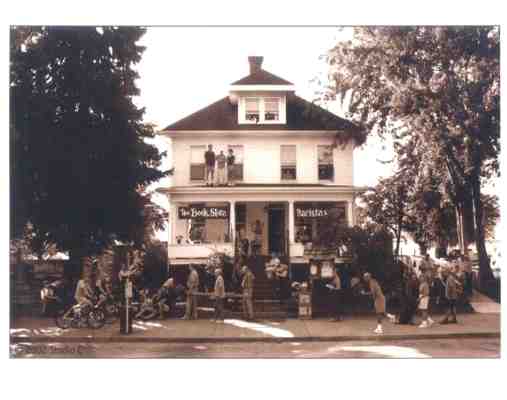
Although New Martinsville, like many West Virginia communities, has struggled economically, one bright example of entrepreneurship is Baristas Cafe & Pub on Main Street where you can drink locally and think globally. Baristas is a great place to hang out any time of the day or night and get a coffee, have some brick oven pizza or sip a Guiness.

How many baristas can claim a feature article in the New York Times written by Rebecca Skloot who sometimes escapes to the hills of Wetzel County to write (and blog)? Skloot's article captures the early essence of Baristas' opening in New Martinsville, and although probably an over simplified view of my howetown, gives a glimpse at the comparison between the old and new economy existing in West Virginia.

Another shining example of creative entrepreneurship in Wetzel County is Thistle Dew Farms and Mountain Craft Shop located "out Proctor." Thistle Dew is owned by Ellie and Steve Conlon who left Philadelphia with two bee hives in 1974.
Today they operate an environmentally friendly beekeeping business with over 700 bee hives and produce some of the sweetest stuff that West Virginia offers. In 2002, they acquired the Mountain Craft Shop, a business founded in 1963 by folk toy master Dick Schnacke. Thanks to the Conlons', the amazing vision, creativity and tradition of Mr. Schnacke continues -- employing local woodworking artisans and giving children around the globe (including my own) the experience of a whimmydittle or flipper dinger.

Below is a guest commentary by the President of Bethany College, Dr. Scott D. Miller, highlighting the new economy opportunities being developed at Bethany College in Bethany, West Virginia.

I approached President Miller with this project because I thought it important to highlight what I think is the best kept educational and community experience in West Virginia -- the Bethany Community. My undergraduate years (1984-88) were spent at Bethany and provided me with education and experience to become a successful health care and technology lawyer. President Miller's latest editorial in the West Virginia State Journal, "It's Time to Get Serious About Global Awareness," is the type of innovative and progressive thinking that goes on at Bethany. The editorial is timely in light of the topics to be discussed at the Create WV Conference.

Below is guest commentary provided to me by Dr. Miller:

"West Virginia in the 21st Century: A World Without Borders - A Future Without Limits."


At Bethany College, we are preparing students to participate in a new world defined far more by intellectual limitations than geographic boundaries. The majestic mountains and raging rivers that created West Virginia’s borders stood as barriers to progress in the past. But as our state moves forward into the 21st Century, technology has given us the opportunity to play a major role in a world without borders and a future without limits.

I devoted my September Higher Education column in the State Journal to exploring how our state’s colleges and universities could best groom our students to compete in a marketplace where Beijing is a mere mouse click away from Buckhannon. The success of three alumni illustrates the unlimited potential that awaits individuals who are willing to embrace the concept of global awareness with innovation and creativity. Thomas Buergenthal is the only American Judge on the International Court of Justice in The Hague, Netherlands. Gregory Jordan, Chairman of our College’s Board of Trustees, is Global Managing Partner for Reed Smith, LLP, one of the largest law firms on the planet. George “Ken” Bado helps shape how we view the world – literally – he serves as Executive Vice President of Sales and Service for Autodesk, a company whose computer technology helps build the largest dam in the world in China, and provides special effects for most of the movies you view.

We believe it’s important to be on the cutting edge of providing new and challenging opportunities for students to expand their academic horizons. John Osborne, our Director of Career Counseling and Placement, has a “been there, done that” style. After graduating from Bethany, he spent 16 years in a variety of senior management positions with Apple Computer and another decade in management at IBM. There’s no substitute for a counselor with personal experience when your son or daughter is trying to chart out the next 40 years of his life.

We’ve put these ideas into practice outside our classrooms, as well, with the Camp Canyon youngsters who visit our campus each summer. Our unique staffing arrangement, which utilizes local college-level coaches and instructors along with American and international “skill-specific” professionals, gives us the flexibility to create multiple specialty camp experiences in a traditional “summer camp” setting.

The 21st Century offers opportunities and challenges for West Virginia and West Virginians. It’s time for us to realize that borders are nothing more than lines on a map in this increasingly global economy.

Dr. Scott D. Miller
President
Bethany College

Work In Progress: West Virginia Creativity

Check back tomorrow for more on the Creative Communities Under Construction Project. I'll be posting tomorrow on elements of the new economy in my hometown of New Martinsville.


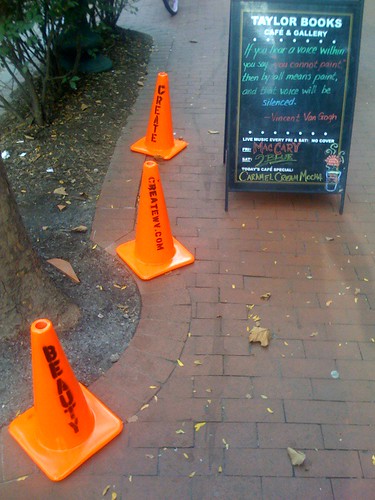
Signs around Charleston have started to appear . . .